
Solar screens
Blocking summer sun: screens, tint, awnings and blinds compared
Shading on the outside of the window, such as solar screens, awnings and exterior shades, stops the most heat because the sun never reaches the glass, while inside options like blinds, cellular shades and drapes are cheaper and adjustable but let some heat in first. For Reno's short, hot summers and long winters, the best choice is usually something outside that you can remove or open in winter.
Updated · A-Affordable Screen, Sparks
Outside beats inside
Once sunlight passes through glass and hits a blind or curtain, much of its heat is already in the room. DOE puts the scale of it this way: 'In cooling seasons, about 76% of sunlight that falls on standard double-pane windows enters to become heat.'
The Department of Energy's Energy Saver guidance says exterior shutters and shades are 'most effective at reducing solar heat gain,' and a 2024 Lawrence Berkeley National Laboratory handout on affordable shading lists exterior-mounted solutions as the ones that 'provide the highest protection from solar heat.' The same handout advises permanent shades, 'preferably on the outside.' That is the idea behind exterior shading.
That does not make inside coverings useless. It means that if one west window is the problem, the biggest gain comes from stopping the sun before it touches the glass.

The options at a glance
The table compares the common choices on the points that matter most in a Reno-Sparks home. Relative cost is a typical ranking per window, not a price, and it varies widely with size and product.
| Option | Where it sits | Blocks heat before the glass | Removable or openable for winter | View out | Relative cost |
|---|---|---|---|---|---|
| Solar screens | Outside, over the window | Yes | Yes, can be taken down | Kept, softened by the weave | Medium |
| Awnings | Outside, above the window | Yes, when the sun is high | Awnings that roll up come in on gusty days; fixed ones stay | Kept below the awning | Medium to high |
| Exterior roller shades and shutters | Outside, lowered when needed | Yes | Yes, raised or opened | Blocked when closed; open-weave shades keep some | Typically the highest, more for motorized |
| Window film | On the glass, usually inside | No, works at the glass | No, stays on all year | Clearest of all | Medium |
| Cellular shades | Inside | No | Yes, raised in winter by day | Blocked when closed | Medium |
| Blinds | Inside | No | Yes, opened | Adjustable | Low |
| Drapes | Inside | No | Yes, opened | Blocked when closed | Low to medium |
Relative cost is a general industry ranking, not a quote. Our solar screen cost guide explains what drives screen prices.
Solar screens (exterior)
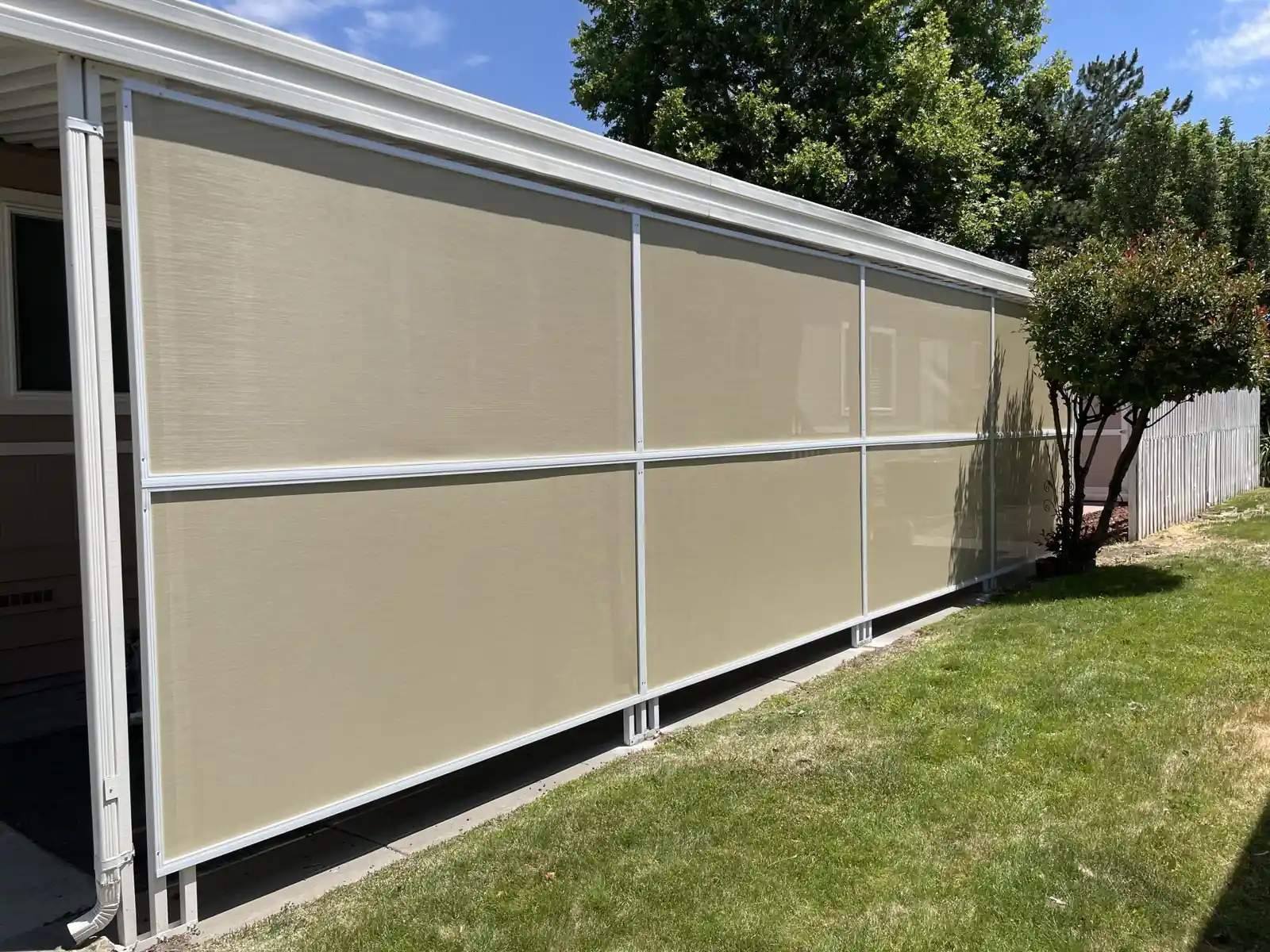
Woven sun-control fabric in a frame over the outside of the window. DOE: 'Solar screens can reduce solar heat gain, UV damage, and glare,' and 'typically allow for a view out the window and light transmission.' The trade-off is set by openness: more open fabric gives a better view and less protection, which our 80 vs 90 percent guide explains. Screens can be removed for winter, and on opening windows they also keep bugs out. The DOE page gives no single percentage for solar screens, so be skeptical of anyone who quotes one as a government figure.
Awnings (exterior)
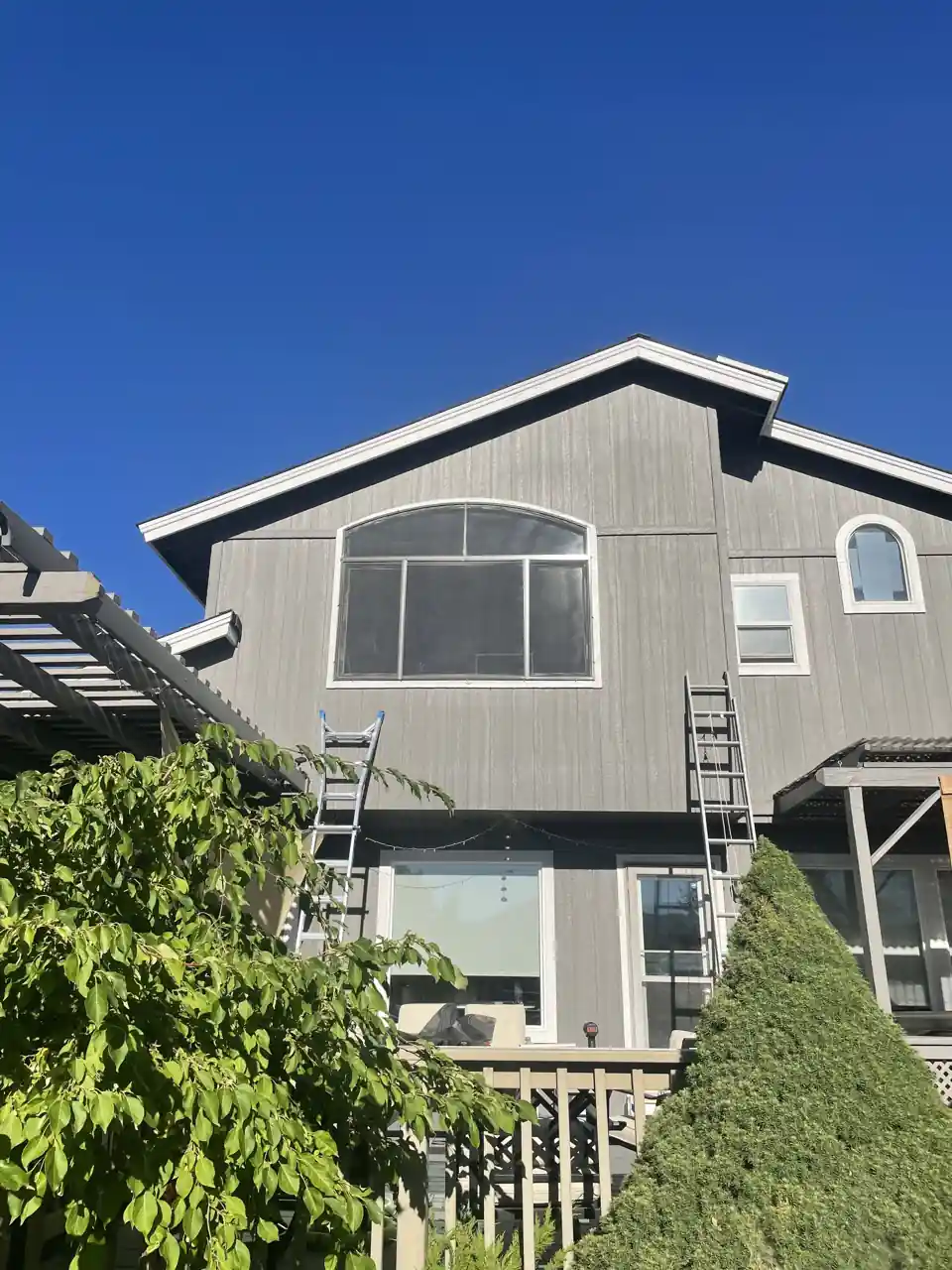
A roof-like fabric or metal shelter over the window. DOE: 'Window awnings can reduce solar heat gain in the summer by up to 65% on south-facing windows and 77% on west-facing windows.' Those figures are for awnings only. DOE also cautions that awnings 'can increase energy used for heating' and suggests rolling them up or removing them in winter. They work well on south glass, where a short overhang blocks high summer sun but lets low winter sun in.
Reno's afternoon wind is hard on fabric awnings. NOAA's hourly normals put the average 2 to 6 p.m. wind at about 13 mph from April through July, mostly from the west, the local Washoe Zephyr. Awnings that roll up are best rolled in on gusty days. Our wind guide covers what that wind does to screens.
Exterior roller shades and shutters
Fabric, vinyl or slatted shades mounted outside and lowered when needed. DOE notes that with open-weave shades, 'The larger the openings, the less protection from solar gain.' They are the most adjustable exterior option and usually the most expensive, especially motorized ones. On a patio, a fixed patio shade screen of shade fabric does a similar job for the open side of a patio cover or carport.

Window film (on the glass)
A tinted or reflective layer stuck to the glass with adhesive. DOE says films help block solar heat, glare and UV, but are 'best used in climates with long cooling seasons, because they also block the sun's heat in the winter,' and that most window manufacturers void warranties if film goes on insulated double-pane glass. Film keeps the clearest view of any option. Our solar screens vs window tint guide compares the two in detail.
Cellular shades (inside)
Honeycomb fabric shades. DOE: in cooling seasons, cellular shades 'can reduce unwanted solar heat through windows by up to 60%' when installed with a tight fit, and in heating seasons tightly installed ones can cut heat loss through windows by 40 percent or more. They are the best inside option for a climate like Reno's that needs help in both seasons, but they block the view when closed.
Blinds and drapes (inside)
DOE calls blinds effective at reducing summer heat gain and glare, and notes that highly reflective blinds, fully closed and lowered on a sunny window, can reduce heat gain. For drapes, DOE reports that 'medium-colored draperies with white-plastic backings can reduce heat gains by 33%.' Both are inexpensive and adjustable, but the heat has already passed through the glass.
New glass: Low-E windows
Replacing windows is a bigger project than any covering, but it belongs on the list. Many newer windows carry a Low-E coating, a thin layer on the glass that reduces the heat passing through. If your windows are already Low-E, you may need less shading than an older single-pane house, and film may add little. An exterior screen still keeps direct sun off the glass and the floor behind it on the hottest afternoons.
The winter side of the ledger
Most sun-control advice is written for places like Phoenix. Reno is different. NOAA's 1991-2020 normals for Reno-Tahoe International Airport show about 65 days a year at 90 degrees or hotter, but also about 122 nights at freezing or below and 4,669 heating degree days against 1,038 cooling degree days.
The Lawrence Berkeley National Laboratory's 2013 study for DOE put the trade-off plainly: 'Exterior (outdoor-mounted) attachments are generally more effective in saving cooling energy, but that does not always translate to the highest overall energy savings due to a potential increase (penalty) in heating energy.' For central climate zones it found that 'Solar screens and roller shades are effective in saving cooling energy, but they impose a penalty on heating energy.'
The practical answer is to choose shading you can take away in winter. Screens come down, awnings roll up, shades roll up, blinds open. Film is the one option that stays on. Our winter guide covers which screens to take down and how.
Matching the option to Reno-Sparks
- West windows that overheat every afternoon: an exterior solar screen, exterior shade or awning. DOE's awning figure is highest for west glass, and a screen covers the whole window and can come down in winter.
- South windows: an awning or a removable solar screen, taken down or rolled up in winter, so low winter sun through south glass can still warm the room.
- East bedrooms: a solar screen or a room-darkening inside shade.
- Big fixed picture windows: film, or an exterior shade if a screen cannot be mounted.
- Storefronts and offices: commercial solar screens on west glass, film where display windows must stay clear.
- Patios and carports: sun-shade screen walls or shade fabric rather than window products.
- North windows: rarely need sun control. A standard window screen for fresh air is usually enough.
- Every room: use what you have. DOE notes that 75 percent of residential window coverings stay in the same position every day; closing west blinds at 2 p.m. costs nothing.
Layering: using two at once
The options are not either-or. A common and sensible setup is an exterior solar screen for summer heat and glare plus an inside blind or cellular shade for night privacy and winter warmth. The screen handles the afternoon sun; the inside covering handles the evening and the cold months.
The same thinking works across a house. Homes in Sun Valley and the North Valleys often have a mix of window sizes and directions, and one answer rarely fits all of them. Start with the two or three windows that cause the most trouble, usually west-facing sliders and bedroom windows, and see how the house feels before doing more. Whether solar screens are the right first step for your home is the subject of our guide on whether solar screens are worth it.
Questions
Straight answers
What is the best way to block heat from windows?
Shade the outside of the glass. DOE and LBNL both rank exterior shading as the most effective at stopping solar heat. Solar screens, awnings and exterior shades all qualify.
Are solar screens better than blinds?
For heat, generally yes, because they stop sunlight before it reaches the glass. Blinds are cheaper, adjustable and help at night, so many homes use both.
Do awnings or solar screens work better on west windows?
Both help. DOE says awnings can cut summer solar heat gain on west windows by up to 77 percent. A solar screen covers the whole window, keeps bugs out of an open window and comes down easily for winter.
What is the cheapest way to block sun?
Closing the blinds or drapes you already have on sunny windows in the afternoon. After that, compare quotes for exterior options on your worst few windows.
Are there rebates for solar screens in Reno?
Neither NV Energy nor the State of Nevada offers one for a typical homeowner, and the federal 25C credit ended for property placed in service after 2025. Income-qualified households can ask the Nevada Weatherization Assistance Program, which lists solar screens among its common improvements.
Do solar screens help with wildfire smoke?
No. Screens and shades do not filter smoke. Close the windows and follow air-quality guidance on smoky days.
Sources: U.S. DOE Energy Saver: Energy Efficient Window Coverings (archived Jan. 1, 2026) (opens in a new tab) · LBNL / PNNL for U.S. DOE (2024): Saving lives through affordable shading (opens in a new tab) · LBNL for U.S. DOE (2013): Energy Savings from Window Attachments (opens in a new tab) · NOAA NCEI: U.S. Climate Normals 1991-2020 (Reno-Tahoe International Airport) (opens in a new tab) · Nevada Housing Division: Weatherization Assistance Program (opens in a new tab)
Since 1997 · Sparks, Nevada
Ready for a free quote?
Call or text us. Or leave your details and we call or text you back.
Monday-Friday 8:00 am-4:00 pm
We come to you anywhere in the Reno-Sparks area to measure and quote, at no charge.