
Solar screens
Should you take solar screens off in winter?
In Reno-Sparks it usually pays to take solar screens off south-facing windows for winter, because the area needs about four and a half times more heating than cooling and low winter sun through south glass is free heat. Screens on north windows, and on west windows you keep for privacy or fading, can often stay up.
Updated · A-Affordable Screen, Sparks
Reno is a heating town first
It is easy to think of the high desert as hot, but the numbers say otherwise. NOAA's 1991-2020 climate normals for Reno-Tahoe International Airport show about 4,669 heating degree days a year and only 1,038 cooling degree days. Degree days measure how far each day's average temperature sits from 65 degrees, so they track how hard a furnace or air conditioner has to work. Here, heating demand is roughly four and a half times cooling demand.
The heating season is long, too. December alone carries about 892 heating degree days and January about 871. Only June through September add meaningful cooling degree days, and even May and October show heating demand in the normals.
A month-by-month screen calendar
The table pairs NOAA's normals with a simple suggestion for south-facing solar screens. West and north screens can usually stay up all year; east screens are a judgment call.
| Month | Average high | Days at 90F+ | Heating degree days | Cooling degree days | South screens |
|---|---|---|---|---|---|
| May | 74.1F | 1.5 | 187 | 43 | Put back up late in the month |
| June | 84.6F | 10.2 | 47 | 173 | Up |
| July | 93.9F | 23.9 | 3 | 379 | Up |
| August | 92.1F | 21.8 | 3 | 316 | Up |
| September | 83.8F | 7.5 | 57 | 118 | Up |
| October | 70.4F | 0.2 | 317 | 8 | Take down mid to late month |
| November to April | 47F to 65F | 0 | 404 to 892 a month | 0 to 2 | Stored |
Degree days rounded to whole numbers. In a hot fall, leaving screens up a couple of extra weeks does no harm. More charts are on our Reno-Sparks sun and climate data page.
What the research found
Lawrence Berkeley National Laboratory ran more than 16,000 energy simulations for the Department of Energy in its 2013 study Energy Savings from Window Attachments. For central climate zones, it concluded: 'Solar screens and roller shades are effective in saving cooling energy, but they impose a penalty on heating energy, making them largely ineffective in saving overall energy.'
The study also looked at Denver, another high, dry, heating-dominated city. In LBNL's modeled results for a gas-heated house with double-pane low-e windows there, solar screens showed a small net increase in total annual energy use for every screen quality tested. The summer savings were real; the winter penalty was larger.
The Department of Energy gives the same seasonal advice for awnings, a close cousin of solar screens: 'keep awnings installed or closed in the summer and remove or open awnings in the winter.' The logic carries over to any exterior shading you can take down.
How much winter sun there is to catch
Winter sun is weaker, but it is not nothing. NASA's POWER climatology for central Sparks shows about 2.0 kilowatt-hours of sunlight per square meter per day in December and 2.4 in January, against about 8.3 in June. That winter sunshine arrives low in the southern sky, which is exactly where south windows face, so a south window can collect a useful share of it as solar heat gain.
A dense solar screen is designed to stop that same sun. In July you want it stopped. In January you want it in the room. That is the whole case for seasonal removal, and it is why our guide on whether solar screens are worth it treats them as a summer product.
Window by window
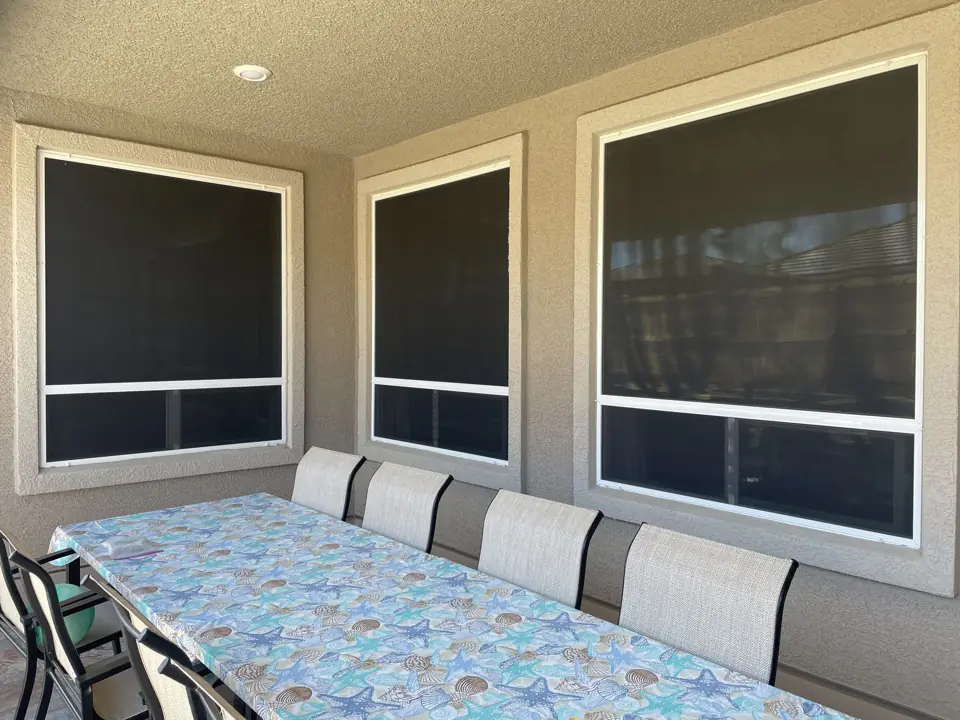
- South: take them down. In winter the sun rides low across the southern sky, so south glass collects the most useful winter sunshine. A dense screen blocks most of it.
- East: your call. Morning winter sun warms a kitchen or bedroom nicely, but if the screen is there mainly for glare or privacy, leaving it up costs less than on the south side.
- West: often leave up. Winter afternoons are shorter and the sun is lower, and many people keep west screens for privacy, glare and fading protection year round.
- North: leave up if you have them. North glass gets almost no direct sun in winter, so there is little heat to lose.
- Snow glare: the EPA notes that snow 'may reflect as much as 80% of UV.' Homes that look out over snowy yards or open ground in the North Valleys sometimes keep a west or east screen up for glare.
Timing the change
The NOAA normals give a practical calendar. Average highs drop to about 70 degrees in October and 57 in November, and 90 degree days are rare after September. They climb back to about 74 in May and 85 in June. For most households that means screens come down in mid to late October and go back up by late May or early June. On a year with a hot fall, waiting a couple of weeks does no harm.
Watch the wind as well. Spring afternoons are among the windiest of the year at the airport, so choose a calm morning for the job. Our Washoe Zephyr guide shows why mornings are the calm window.
Taking them down without damage
- Pick a calm, dry morning. Do one side of the house at a time so nothing gets mixed up.
- Label each screen. A small tag or tape label with the window it came from saves guesswork in spring; similar-looking screens rarely fit each other's openings.
- Bag the hardware. Put clips or turn buttons in a labeled bag so nothing goes missing by spring.
- Clean before storing. Brush or hose off dust and let the screens dry fully.
- Store flat or on a long edge. A garage or shed wall works, but not leaning at an angle where the frame can bow.
- Keep them out of harm's way. Stay clear of sharp tools, bikes and car doors. A dented corner is the most common winter injury.
Putting them back in spring
Spring reinstall is a good time for a quick check. Look at each corner where the fabric meets the spline, press on the frame to see that it is still flat, and make sure every clip or turn button is present and tight. A screen that went into storage with a small gap at one corner will not get better over the summer, and a loose screen is the one the afternoon wind pulls off.
If a frame bent in storage or the fabric has pulled loose, it can usually be rescreened in the same frame. See screen repair and rescreening. Regular insect window screens on north windows can go back in at the same time.
Make removal easy from the start
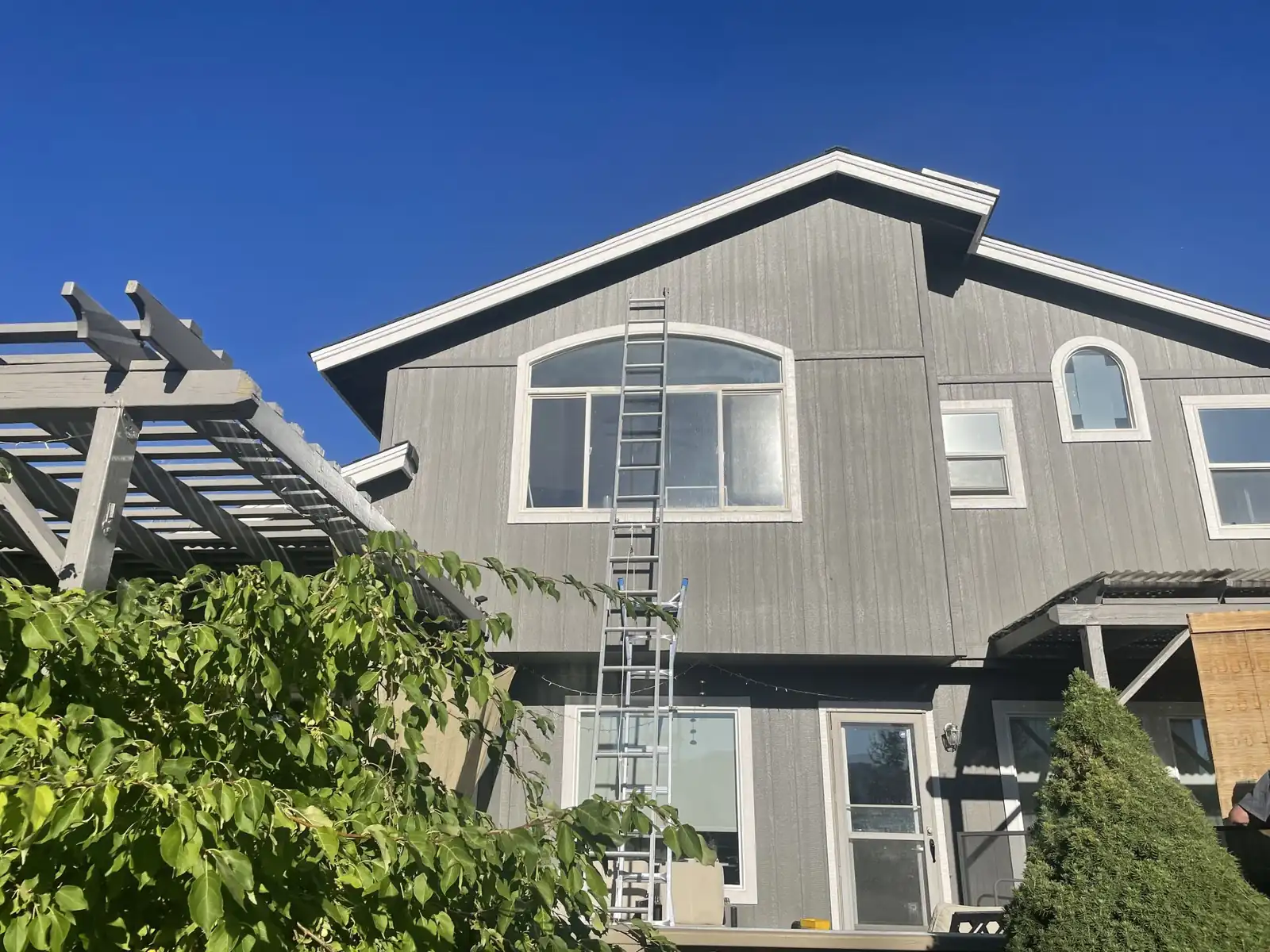
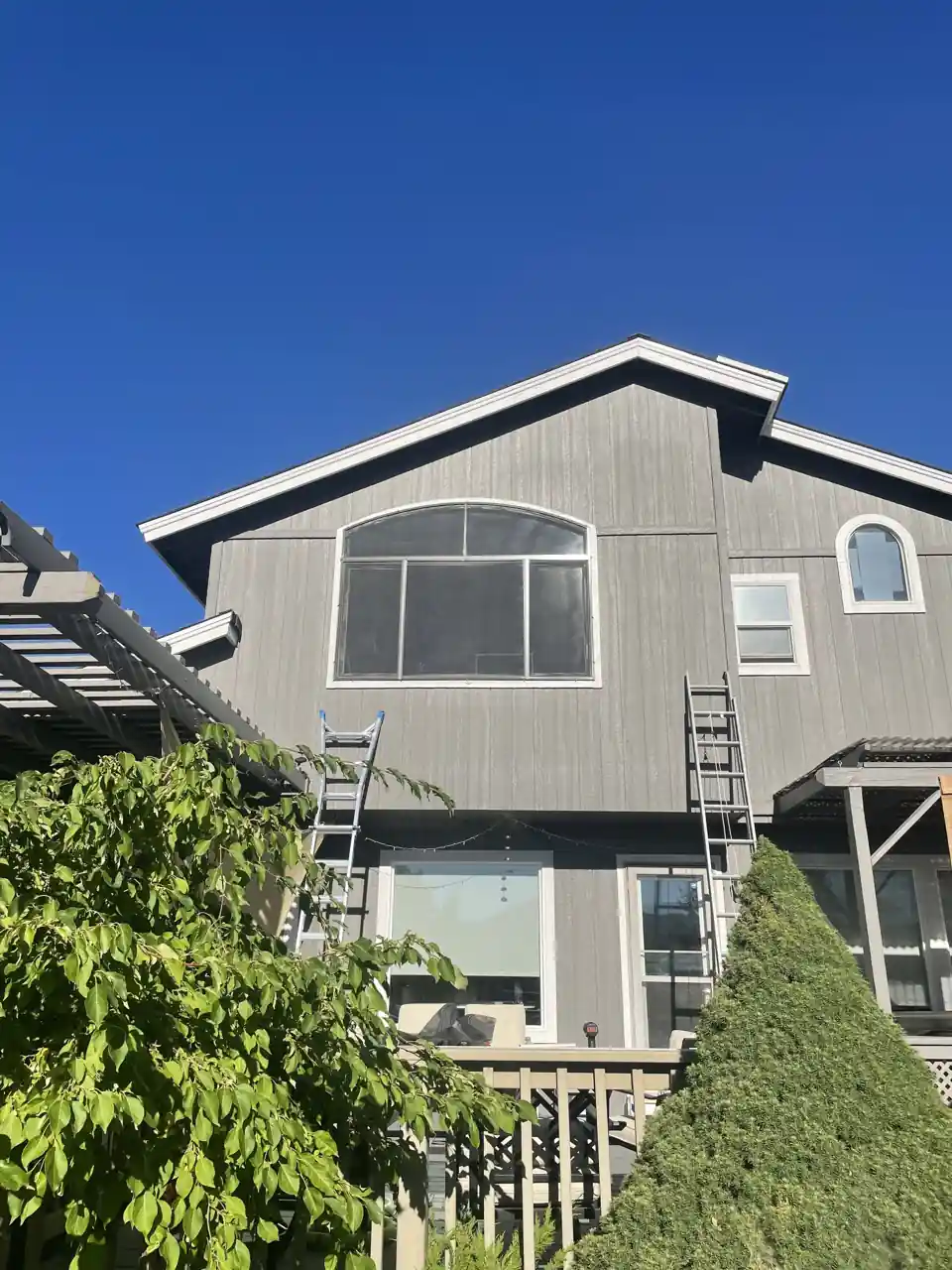
If you know you will pull certain screens each fall, say so before they are built. The mounting hardware chosen for each window, such as clips, turn buttons or retainer clips, affects how quickly a screen comes off and goes back on, and whether you can do it from the ground or need a ladder. Two-story windows are a different question; for many homeowners those screens stay up all year because removing them is not worth the ladder work.
We plan this with you during the free on-site measure and note it on your quote. Fabric choice matters here as well; an 80 percent weave lets in a little more winter light if a screen stays up. Our 80 vs 90 percent guide compares them, and our cost guide covers how hardware choices affect price.
Patio shades and storefront screens
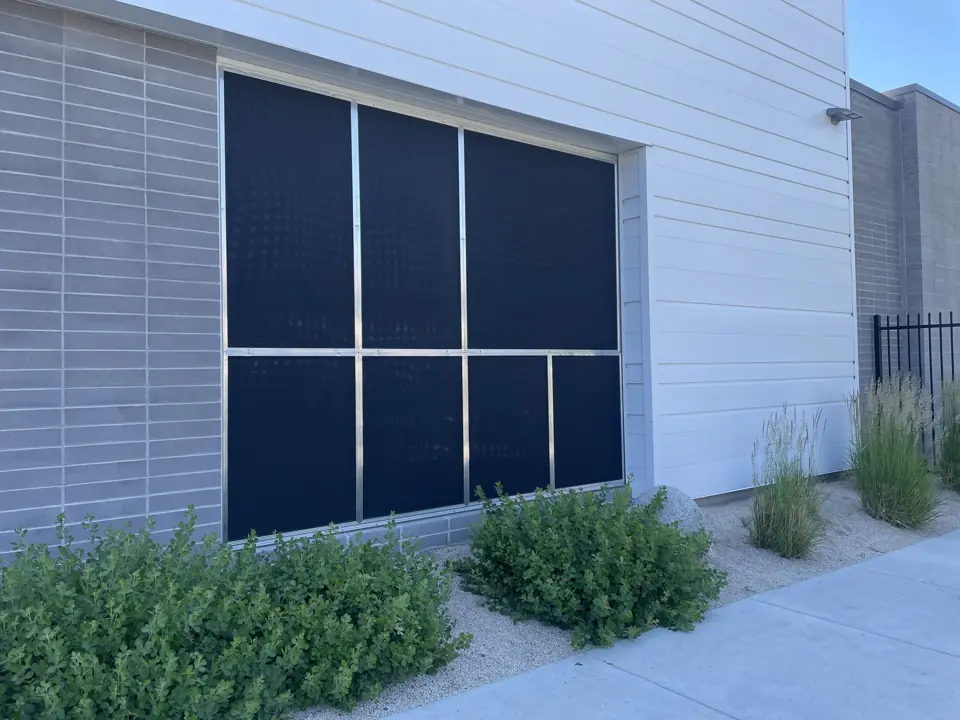
The same thinking applies beyond windows. A sun-shade wall on a south-facing patio blocks low winter sun that could warm the house wall behind it; west-facing patio shade screens are more often left in place. For commercial solar screens on storefronts, glare on customers and staff usually matters more than winter heat, so many stay up year round.
Questions
Straight answers
Do solar screens keep heat in during winter?
Not much. They are designed to block incoming sun, not to insulate. In winter that mostly means they block free solar heat on south and east windows.
When should I take solar screens down in Reno?
Most people remove them in mid to late October and reinstall in late May or early June, based on NOAA's normal highs for Reno.
Is it bad to leave solar screens up all year?
It will not harm the screens, but on south windows it costs you winter solar heat. LBNL found a heating penalty for solar screens in central U.S. climates.
Can snow damage solar screens?
Heavy snow sliding off a roof can bend frames, so screens under a roof edge are good candidates for winter storage.
Sources: NOAA NCEI: U.S. Climate Normals 1991-2020 (Reno-Tahoe International Airport) (opens in a new tab) · LBNL for U.S. DOE: Energy Savings from Window Attachments (Oct. 2013) (opens in a new tab) · U.S. DOE Energy Saver: Energy Efficient Window Coverings (archived Jan. 1, 2026) (opens in a new tab) · NASA POWER climatology (Sparks, 2001-2020) (opens in a new tab) · U.S. EPA: A Guide to the UV Index (opens in a new tab)
Since 1997 · Sparks, Nevada
Ready for a free quote?
Call or text us. Or leave your details and we call or text you back.
Monday-Friday 8:00 am-4:00 pm
We come to you anywhere in the Reno-Sparks area to measure and quote, at no charge.