
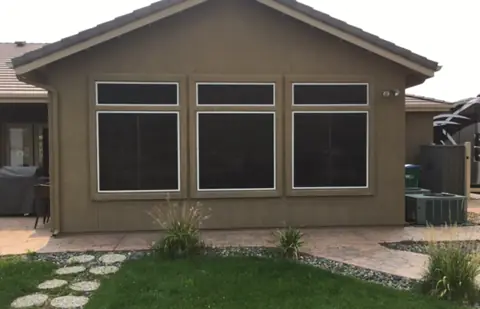
Solar screens
Solar screen colors, views and daytime privacy
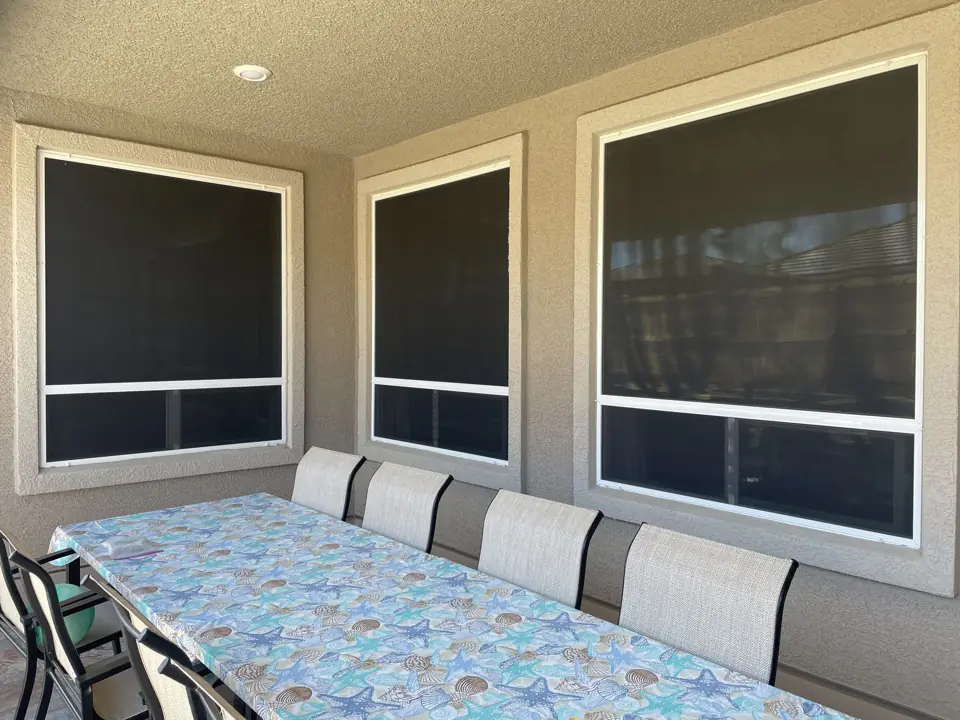
Darker solar screen colors such as black, bronze and brown are easier to see through from inside, while lighter colors like beige and stucco reflect more heat but look hazier from indoors. Either way, solar screens give good privacy during the day, and that privacy reverses at night once your lights are on.
Updated · A-Affordable Screen, Sparks
Color changes what you see
Most people pick a solar screen color to match the house, and that is a fine place to start. But color also changes the view out. Twitchell, the maker of Textilene fabrics, explains it this way in a 2024 specification sheet for its Sunsure shade fabric: 'Light colors are more reflective with a lower heat gain, and are more difficult to see through. Darker colors provide better daytime visibility.'
The reason is simple. A light fabric bounces sunlight around its own surface and glows, so your eye sees the fabric instead of the yard behind it. A dark fabric absorbs that light and almost disappears, the same way a black insect screen is easier to look through than a gray one.
Typical color families
Colors vary by maker and product line. As one example, Phifer lists its SunTex solar screen fabric in beige, black, brown, dark bronze, grey and stucco. We bring physical samples to your home because a small swatch on a phone screen tells you very little about how a color looks against your stucco, siding or trim in Reno's bright light. The table below sums up how the families typically behave.
| Color family | View out by day | Look from the street | Heat and glare | Often chosen for |
|---|---|---|---|---|
| Black, dark bronze | Clearest | Blends with dark window glass; the screen almost disappears | Absorbs more sun at the fabric; strong glare control | View windows, TV rooms, modern exteriors, bronze window frames |
| Brown, grey | Good | Reads as a soft, neutral panel | Middle ground | Earth-toned stucco, mixed trim colors |
| Beige, stucco | Hazier, the fabric glows in direct sun | Blends with light stucco walls | More reflective, lower heat gain per Twitchell | Light stucco homes, rooms where the view matters less |
Twitchell's Textilene Sunsure specification sheet is the source for the reflective and visibility statements. Exact figures differ by maker, color and weave.
Color and weave work together
Openness, the share of the fabric that is open, affects the view even more than color. Phifer's published visible transmittance figures for SunTex show roughly 36 to 39 percent of visible light getting through the 80 percent weave and roughly 18 to 20 percent through the 90 percent weave, depending on color. So a dark 80 percent fabric gives the clearest view, and a light 90 percent fabric gives the dimmest. Our 80 vs 90 guide goes deeper on openness.
A common pattern is one color on every window for a tidy look from the street, with the weave changing by direction: 90 percent on hot west and east glass, 80 percent where the view is the point.
How daytime privacy works
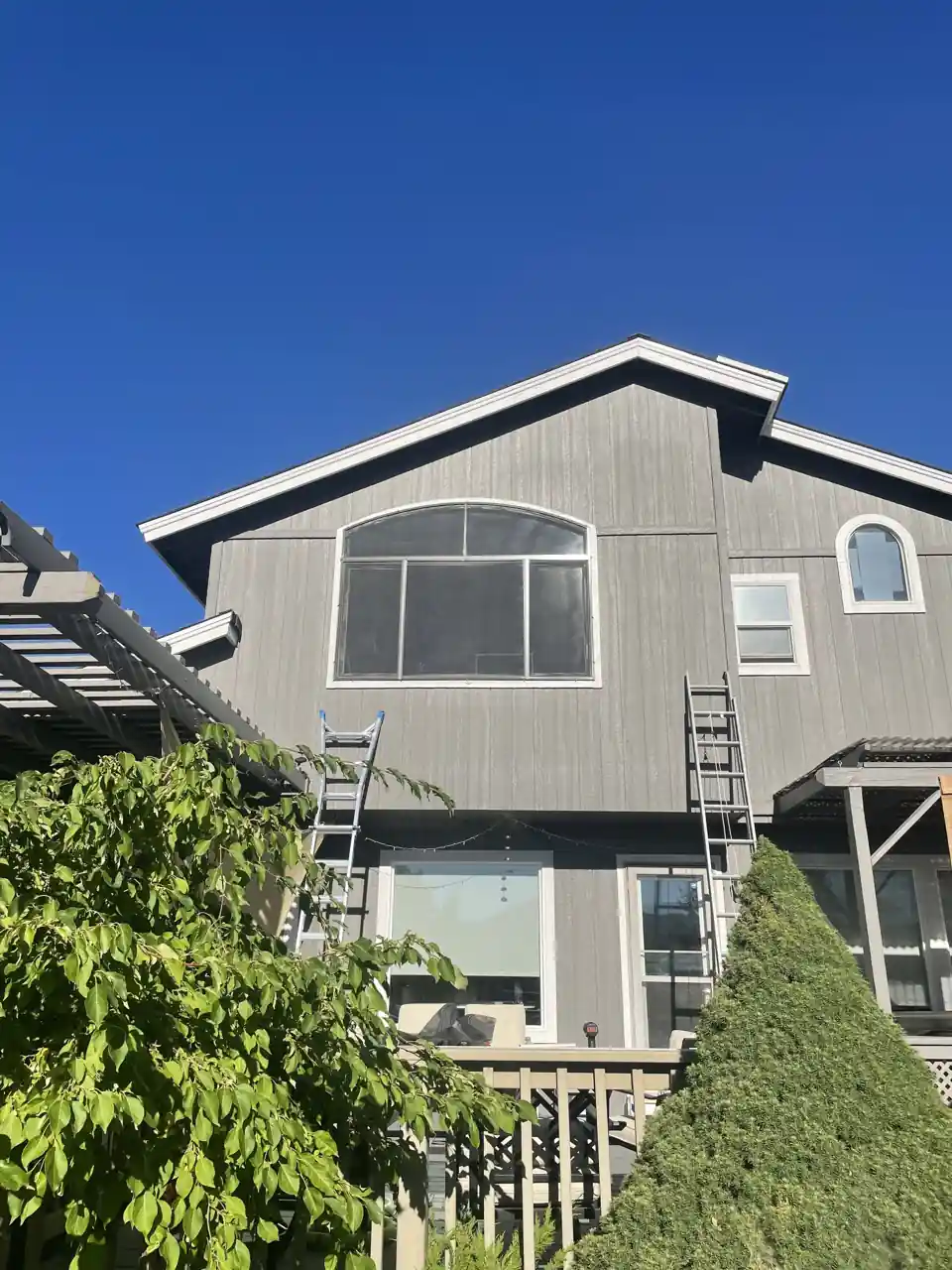
During the day, the outside is far brighter than the inside of your house. Someone on the sidewalk sees the sunlit face of the fabric and very little behind it, while you, sitting in the dimmer room, look out toward the bright yard and see through the weave. Phifer lists daytime privacy as one of SunTex 80's features, and the effect is stronger with a tighter weave.
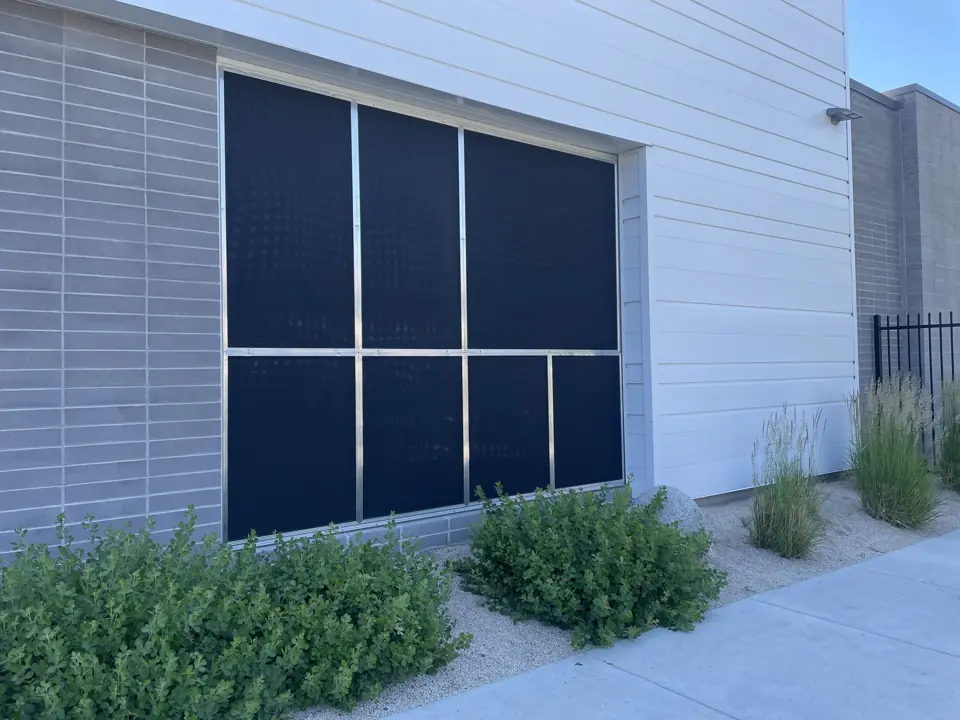
That makes solar screens popular on street-facing bedrooms, front living rooms and bathrooms with clear glass, and on offices and storefronts where people inside want to see out without being on display. Our commercial solar screens page covers storefront glass.
Privacy is strongest where the sun is strongest
Because the effect depends on the difference in brightness, it is not the same on every side of the house. A west window in full afternoon sun gives very good privacy; the fabric face is bright and the room behind it is comparatively dark. A north window, or a window under a deep patio cover, has less light on the fabric, so the difference is smaller and people outside can see in more easily.
Reno helps here. NOAA's 1991-2020 normals put the summer average high at about 90 degrees, and NASA's POWER climatology for Sparks shows about 8.3 kWh of sunlight per square meter per day in June, roughly four times December's level. Long, bright summer days mean strong daytime privacy through the warm months, whether the house is in Spanish Springs, South Reno or anywhere between. Short winter days mean the switch to night privacy rules comes early in the evening. More local numbers are on our Reno-Sparks sun data page.
Why it reverses at night
After dark, the balance flips. With lights on inside, the room is now the bright side and the street is dark, so people outside can see in through the screen, and you see mostly your own reflection. This is true of every screen and every tinted film, not a flaw in one product. Our solar screens vs window tint guide compares the two in more detail.
If night privacy matters, pair solar screens with blinds, shades or curtains you close in the evening. The Department of Energy's window-covering guidance points out that '75% of residential window coverings remain in the same position every day' and encourages using them strategically, which is good advice here too.
| Time | Can people outside see in? | Can you see out? | What to do |
|---|---|---|---|
| Sunny day | Very little, especially with a tight weave | Yes, clearly with a dark color | Nothing extra needed on most windows |
| Overcast day or shaded window | Somewhat more | Yes | Close sheer curtains in rooms that need full privacy |
| Dusk, lights coming on | Increasingly, as the inside gets brighter | Less, reflections start | Close blinds as you turn lights on |
| Night, lights on inside | Yes | Mostly your own reflection | Use blinds, shades or curtains |
Frame color
The aluminum frame shows around the edge of each screen, so its color matters for curb appeal. Many owners match the frame to the window frame or trim so the screen reads as part of the window. Ask to see frame samples along with the fabric, and look at them next to the window, not in the driveway, since a frame that matches bronze window trim can clash with white vinyl a few feet away.
If the house has a mix of window types, for example original aluminum windows on one side and newer white vinyl replacements on another, it is worth deciding up front whether the frames match the windows or match each other.
Color on patios and sliders
The same color logic applies to patio shade screens that close in the side of a patio cover or carport. A dark fabric keeps the view of the yard from the patio chairs; a light fabric blends with a light stucco wall and looks softer from the street. On a patio, where you sit right behind the fabric, the view through it matters more than on a window you see from across a room.
Screens on the rest of the house do not have to match the patio exactly, but most owners keep them in the same color family so the house reads as one design.
How to pick a color
- Check the rules first. If you have an HOA, read its architectural guidelines; some communities limit exterior colors, and some ask for approval before exterior changes.
- Look from inside at the right time. Hold samples against the window at the time of day you use the room, and look out, not at the fabric.
- Look from the street in afternoon sun. That is when the fabric face is brightest and the color reads strongest.
- Match the frame to the window or trim. Compare frame samples right next to the window frame.
- Keep one color across the house. Change the weave window to window if you need to, not the color.
- Weigh heat against view honestly. A light color reflects a bit more; a dark color gives a better view. On most homes the view difference is what people notice day to day.
Questions
Straight answers
Can people see through solar screens at night?
Yes, when your lights are on inside. Daytime privacy comes from the outside being brighter than the inside, so it reverses after dark. Use blinds or curtains at night.
Which solar screen color is easiest to see through?
Dark colors. Twitchell says darker colors provide better daytime visibility, while light colors are more reflective and harder to see through.
Do light-colored solar screens block more heat?
Twitchell notes light colors are more reflective with lower heat gain. Weave density matters too: a 90 percent weave lets through far less light than an 80 percent weave in any color.
Do I need HOA approval for solar screens?
It depends on your community. Check your HOA's architectural rules for exterior colors before you order.
Does screen color change the price?
Usually not by much. Size, count and frame drive the price more than color. Our solar screen cost guide explains what does.
Can I see the colors before I decide?
Yes. We bring fabric and frame samples to your home at the free on-site quote, measure every window, and you choose with the samples against your own walls.
Sources: Phifer: SunTex 80/90 colors and specifications (opens in a new tab) · Phifer: SunTex 80 features (daytime privacy) (opens in a new tab) · Twitchell: Textilene Sunsure fabric specification sheet (Oct. 2024) (opens in a new tab) · U.S. DOE Energy Saver: Energy Efficient Window Coverings (archived Jan. 1, 2026) (opens in a new tab) · NASA LaRC POWER Climatology (2001-2020), point in Sparks (opens in a new tab)
Since 1997 · Sparks, Nevada
Ready for a free quote?
Call or text us. Or leave your details and we call or text you back.
Monday-Friday 8:00 am-4:00 pm
We come to you anywhere in the Reno-Sparks area to measure and quote, at no charge.