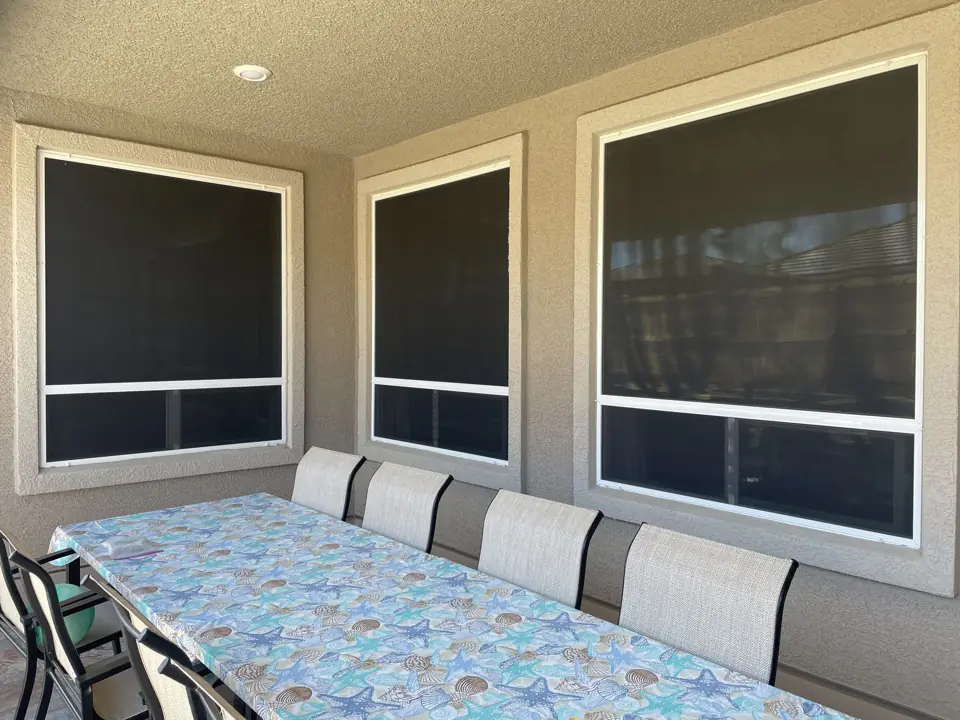
Window screens
Wildfire smoke, pollen and dust: what screens can do
Ordinary insect screens and solar screens do not filter wildfire smoke; the fine particles in smoke are hundreds of times smaller than the openings in any screen mesh. On smoky days the EPA advises keeping windows and doors closed, running fans or air conditioning to stay cool, using a high-efficiency HVAC filter and a portable HEPA air cleaner, and checking conditions on AirNow. Screens keep insects out and stop larger grains and ash, but no screen is an air filter.
Updated · A-Affordable Screen, Sparks
The short answer
People ask whether a tighter screen would help during smoke season. It is a fair question, and the answer is no. Wildfire smoke is made mostly of tiny particles and gases. The particles that matter most for health are the smallest ones, which the EPA calls PM2.5, and they pass through any window screen as if it were not there. Solar screens and pet screens both have openings that are enormous next to a smoke particle.
A screen is for insects, sun and airflow. Clean air on a smoky day comes from closed windows and filtration, and the EPA and AirNow are the places to go for that guidance. Where screens do earn their place is on the clean-air days in between, covered further down.
How small smoke particles are
The EPA describes two sizes of particle pollution. PM10 covers inhalable particles generally 10 micrometers and smaller, and PM2.5 covers fine particles generally 2.5 micrometers and smaller. To give a sense of scale, the EPA points out that the average human hair is about 70 micrometers across, some 30 times larger than the largest fine particle.
Insect mesh is woven in counts like 18 by 16 strands per inch (see mesh count), which leaves gaps of roughly a millimeter. That is roughly a thousand micrometers, hundreds of times wider than a PM2.5 particle. No tightening of the weave that still lets air and light through closes that gap. Our screen mesh guide explains the weaves in more detail.
What screens can and cannot stop
Screens are good at some things in the air and useless against others. The difference is mostly size, and the solar screen on a west window behaves the same as insect mesh here.
| What is in the air | Standard insect screen | What actually helps |
|---|---|---|
| Wildfire smoke (fine particles and gases) | Passes straight through | Closed windows and doors, a MERV 13 or better HVAC filter, a portable HEPA air cleaner |
| Coarse dust and grit | Stops larger grains; fine dust passes | Closing windows on windy afternoons, damp dusting, a HEPA vacuum |
| Pollen | Much of it passes | Windows closed on high-pollen days, a good HVAC filter |
| Ash flakes, leaves, seed fluff | Stops most | Screens help here; clean them after an ash event |
| Mosquitoes, flies, moths | Stops them | Whole, tight-fitting window screens on every opened window |
General guidance. Particle sizes from EPA; screens are not rated as air filters.
What EPA advises on smoky days
The EPA's guidance on wildfires and indoor air quality is clear and practical. Outdoor smoke gets indoors through open windows and doors, through fans and HVAC systems that pull in outside air, and through small gaps around closed windows and doors. The goal is to cut all three.
- Check the air first. Look at AirNow's Fire and Smoke Map, or the Air Quality Index for Reno-Sparks, before opening windows. Northern Nevada Public Health's Air Quality Management Division issues local advisories when regional fires send smoke into the valley.
- Keep windows and doors closed. Shutting the house is the EPA's first step against indoor smoke, with fans and air conditioning doing the cooling. When home cannot be kept cool, EPA advises finding a cooler place to go.
- Set the HVAC to recirculate. Close any fresh-air intake. EPA suggests a MERV 13 or higher filter if your system can take it, fitted snugly and changed on schedule.
- Mind the swamp cooler. An evaporative cooler pulls outside air into the house. EPA advises covering its intakes with 4-inch MERV 13 filters if you can do it safely, or running it sparingly while smoke lingers.
- Run a portable air cleaner in one room. EPA recommends a clean room: a room with doors and windows kept closed and a portable air cleaner running, where the household can spend most of its time.
- Do not add particles indoors. Skip frying, broiling, candles, wood stoves and aerosol sprays, and vacuum only with a HEPA vacuum until the smoke clears.
Pollen and screens
Pollen is a different case from smoke. Pollen grains vary widely by plant, and many are larger than fine smoke particles, so a standard screen stops some of the larger ones while much of the rest passes. A screen lets air through by design, and a room with the window open gets pollen along with the breeze.
A screen is not a filter, and people with allergies will usually do better keeping windows closed on high-pollen days and relying on a good HVAC filter. For heavy-use openings, rescreening is the natural time to refresh worn mesh.
Dust and the afternoon wind
Dust in Reno-Sparks is mostly a wind story. NOAA's hourly normals for the Reno airport show calm early mornings, with average wind of roughly 2 to 4 mph between 5 and 8 am, and a steady afternoon breeze of about 13 mph from April through July, usually from the west. That afternoon wind is what carries grit onto sills and through open windows. The Washoe Zephyr guide covers the pattern.
Screens stop the larger grains, but fine dust drifts through. A practical routine is to air the house out in the calm of the evening and early morning, when the air is clean, and to close the windward side in the windy afternoon hours. Our guide to keeping a Reno-Sparks house cool uses the same timing for night cooling.
Where screens really help
On the many summer days when the air is clean, screens are what let you open up. Reno's nights are cool, and windows open after dark can bring the house temperature down without the AC. That only works with whole screens, because mosquitoes are most active in the morning and evening, and Northern Nevada Public Health has found West Nile virus in mosquito samples in parts of Sparks and South Reno.
Screens also catch ash flakes and debris that blow in after a nearby fire, keep leaves and cottonwood fluff out, and on the sunny side of the house, exterior solar screens cut heat and glare so windows can stay open longer in the day. After a smoky spell, wash the ash off screens; our screen cleaning guide shows how.
Getting screens ready for the season
A-Affordable Screen has worked on Reno-Sparks screens since 1997. Before the windows start opening for summer, we replace torn mesh, build custom window screens for openings that have none, and rescreen sliding screen doors or build custom new ones, across Sparks, Reno and Northwest Reno. Terms used here are defined in our glossary, and how it works explains the free on-site measure. More answers are on our FAQ page. Call or text (775) 240-0418, or ask for a free quote.
Questions
Straight answers
Do window screens filter wildfire smoke?
No. Smoke particles are 2.5 micrometers and smaller, and screen openings are hundreds of times wider. Keep windows and doors closed on smoky days, as EPA advises.
Do solar screens block smoke?
No. Solar screens block sun and glare, not particles. Smoke passes through them just as it passes through insect mesh.
Is there a screen that filters pollen?
No. A screen is not a filter and it lets air through by design. Closing windows on high-pollen days and using a good HVAC filter does more.
What should I do on a smoky day in Reno?
Check AirNow, keep windows and doors closed, run the HVAC on recirculate with a MERV 13 filter if it fits, use a portable HEPA air cleaner in one room, and avoid adding smoke or particles indoors.
Should I run my swamp cooler when it is smoky?
EPA advises covering an evaporative cooler's intakes with 4-inch MERV 13 filters if you can do it safely, or using it sparingly during smoke because it pulls outside air in.
Does a screen keep out dust?
It stops larger grains, but fine dust still passes. Closing the windward windows on windy afternoons does more.
Sources: U.S. EPA: Wildfires and Indoor Air Quality (opens in a new tab) · U.S. EPA: Particulate Matter (PM) Basics (opens in a new tab) · AirNow (EPA and partners): Wildfires and the Fire and Smoke Map (opens in a new tab) · Northern Nevada Public Health: Air Quality Management Division (opens in a new tab)
Since 1997 · Sparks, Nevada
Ready for a free quote?
Call or text us. Or leave your details and we call or text you back.
Monday-Friday 8:00 am-4:00 pm
We come to you anywhere in the Reno-Sparks area to measure and quote, at no charge.